Starlink can have a lower network latency than a fiber optic link. [1]
1. Data drag race
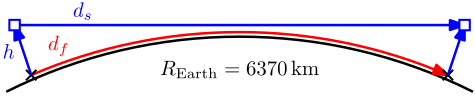
Compare the delay experienced by a network datagram sent over a terrestrial fiber optic link versus a one sent via a 2-satellite hop.
This problem setup is very similar to using free-space communications (through air: laser or microwave) versus fiber without the space component. The only material difference is that a terrestrial link’s antenna is on a tower, and therefore the maximum distance between points is limited by the tower height. Think of this Starlink setup as really tall antenna towers.
1.1. Information
The line-of-sight distance from a point h above the surface (e.g. a tall tower or orbiting satellite) to the horizon is given by:
Remember that the distance between two towers is double this distance — the wave just grazes the surface at the path’s midpoint.
-
Look up the typical propagation velocity of light in single-mode fiber:
from reference
| Field | Control | Duration | Dest. Address 1 | … |
|---|---|---|---|---|
length (octets) |
2 |
2 |
6 |
| Field | Preamble | Start | Dest. Address | … |
|---|---|---|---|---|
length (octets) |
7 |
1 |
6 |
1.2. Assumptions
-
Assume that the network switch on a Starlink satellite operates in cut-through mode, meaning that the switch buffers the frame for only the time needed to determine the destination address of the datagram and immediately begins re-transmitting the frame (before receiving the rest of the datagram’s content). For example, for an 802.11 WiFi datagram, the unit would record/buffer the first 10 octets (80 bits) before it starts the output transmission.
-
Assume the bit rate of the link is 10 Gb/s (10×109 bit/s).
1.3. Questions
-
Compute the delay for an arbitrary fiber distance df (use km units).
-
Compute the latency of an IEEE 802.3 Ethernet frame with a payload size of the MTU of 1500 bytes for arbitrary distances (e.g. df).
-
At what distance does the end-to-end delay of fiber equal the delay of two cut-through switches but transmission in air/vacuum?
-
A point-to-point microwave link can have a switch delay approaching zero (since there need not be a network switch to route the datagram to the appropriate output port). What is the delay of a p-p microwave link compared to a direct fiber link?
-
Compute the maximum total (source → starkinkA → space → starlinkB → destination) distance if the Starlinks are orbiting at an altitude of h km.
-
Find the combinations or joint ranges of h and df where sending an 802.3 Ethernet frame with a 1500 byte payload over Starlink has a lower latency than when sent over fiber.
-
Find the average orbital altitude h of the operational Starlink satellites.
2. References
https://celestrak.org/NORAD/elements/table.php?GROUP=starlink&FORMAT=csv — Current orbital information for all Starlink satellites.