Instructions
-
Part A is take-home.
-
Part B is given during class Monday and relates to the same content coverage.
-
N.B.: Part B presumes you are mostly done with Part A.
- Rules for Part B
-
-
Closed notes, book, readings, ICEs, challenges.
-
No computing devices — desk-under, desk-top, lap-top, palm-top, head-worn, neural-embedded, etc.
-
Your work completed thus far for Part A is allowed. Print it out if needed.
-
(no calculator is needed)
-
The name for this torture pedagogical technique is active recall.
Your brain does not like being required to work like this.
1. Coordinate systems


1.1. Nomenclature and handedness
| Set | System (cart/pol/cyl/etc) | Right or Left-handed |
|---|---|---|
\((x, y, z)\) |
||
\((z, x, y)\) |
||
\((\rho, \phi, z)\) |
||
\((r, \phi, \theta)\) |
||
\((z, y, x)\) |
||
\((z, \phi, \rho)\) |
||
\((r, \theta, \phi)\) |
1.2. Earth coordinates
Taking the center of the Earth as the origin of a right-handed cartesian coordinate system, with \(\hat{a}_z\) along its axis of rotation towards the North pole, and \(\hat{a}_x\) in the direction of (0, 0) (lat, long) (Null Island),
convert the location of Gellersen Engineering and Mathematics Center
(41.463° lattitude, −87.038° longitude) to the polar coordinates system as defined in this course.
2. Coulomb’s Law
Please state what you know about Coulomb’s Law. Include the equation for electric field that is defined/derived from this law.
3. Gauss’s Law
State what you know about Gauss’s Law. Include the point and integral forms. Also, state the simplification that has been most commonly been used thus far in calculating the electric field
4. First of Maxwell’s equations
What is the first full equation from the set of Maxwell’s equations that we’ve covered thus far? What is the first constitutive equation?
Give the point and integral forms.
5. Field and voltage
An electric field is “conservative”, which is useful when computing the voltage potential difference between two points for a given E-field.
→ Does this “conservative” property hold if/when the path of integration passes through a region of different relative permittivity (\(\epsilon_r\))?
6. Capacitor technologies
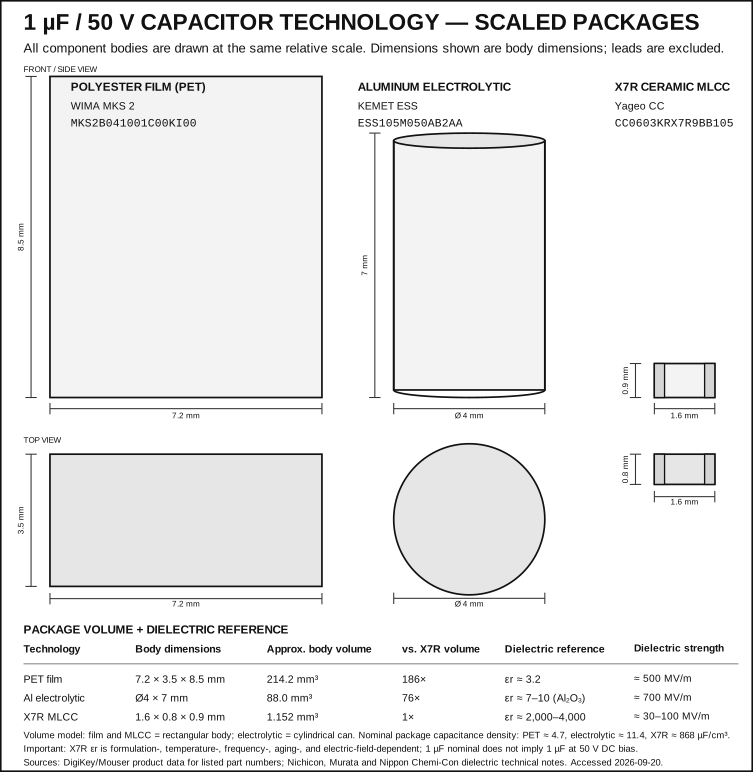
These three real capacitor models have the same rated capacitance and maximum voltage, yet are wildly different sizes. All achieve their size’s thickness by effectively either taking a long parallel-plate “strip” capacitor and rolling it up into a (smashed) cylinder or making a stack of many plates to convert the plate area into a 3D volume.
Describe what factors would contribute to these vast size differences, given the same capacitance and maximum voltage rating, using what you have learned from the course’s subject material.