1. Tsiolkovsky’s Boat
Imagine that you are on a boat in the water, rowing across a lake. Unfortunately, you lost grip on your oars and they have floated away from you. You do not have any other way of propulsion, it seems.
You think to yourself, “Gee, next time I will tie a rope to my oars. But how am I going to return to shore?”
Fortunately you notice that your boat is loaded with a pile of stones, which, at the moment, are your only companions.
Being a good student, you remember your physics class where you learned about Newton’s three laws of motion:
- Newton’s 1st Law of Motion
-
Every body continues in its state of rest, or of uniform motion in a straight line, unless it is compelled to change that state by forces impressed upon it.
- Newton’s 2nd Law of Motion
-
The change of motion of an object is proportional to the force impressed and inversely proportional to the object’s mass; and is made in the direction of the straight line in which the force is impressed.
- Newton’s 3rd Law of Motion
-
To every action there is always opposed an equal reaction; or, the mutual actions of two bodies upon each other are always equal, and directed to contrary parts.
Since the stones are not very talkative companions, you consider how to relate these Laws to your present situation.
1st Law: There is no wind and the boat is not moving in the water (its velocity is zero). Therefore, you know that you are not going anywhere unless there is some force that acts on your boat.
2nd Law: There are no forces now, so there isn’t any change of your motion — not helpful at the moment.
3rd Law: Finally you have an idea! What if you can make a force on the boat in one direction, then the boat would have motion in the opposite direction, when you combine this idea with the 2nd Law.
Awesome!
You pick up a stone and swing it from side-to-side. The stone goes one direction but the boat slides in the opposite direction, just as predicted.
Unfortunately, swinging the stone the other direction brings both the stone and the boat back to their original positions, back to the middle of the lake.
You realize that to continue moving in the direction of the shore, you must NOT pull the stone back towards you and only push it away from you. Obviously, this means that you must throw the stone over board.
(We are assuming that your boat is really nice and that it has no resistance to moving through the water and so continues moving at a constant velocity, not slowing down [1])
You say to the stones, "Nice spending time with you, but we must depart from each other."
The stones say nothing, as usual.
Then you proceed to pick up each stone and throw it over board in the opposite direction of the shore. At each toss, the boat (and you) move at a larger velocity towards the shore.
Eventually you throw the last stone and take stock of your situation.
-
The boat contains no more stones, and therefore has a smaller mass than the start of this adventure.
-
You are tired from throwing all of those stones.
-
The boat is moving at a velocity vboat in the direction of the shore.
-
You notice that each of the stones you threw are still moving at a velocity away from you, sinking at the same time to the depths of this curious superfluid lake. (This fact is … nice … but no longer has useful meaning for you. Unless, of course, you enjoy watching stones.)

This situation is what Kostantin Tsiolkovsky used as a thought experiment to consider how a rocket moves in space.
1.1. The Rocket Equation
The Tsiolkovsky rocket equation describes the motion of a rocket, which here means a device that can accelerate itself by expelling part of its mass away at a high velocity. If there are no other influences on the object (such as air resistance), then the final velocity of the rocket is determined by the rocket exhaust, the initial mass of the rocket (including its fuel), and the final mass of the rocket after it has run out of fuel.
It was independently first derived by several people in history — Tsiolkovsky gets the credit for being the first to use it to determine if rockets could escape Earth’s gravity.
| 1810 |
British mathematician William Moore |
| 1903 |
Russian scientist Konstantin Tsiolkovsky |
| 1912 |
American engineer and physicist Robert Goddard |
| 1920 |
German engineer Hermann Oberth |
1.1.1. Most popular derivation
Consider the following system:
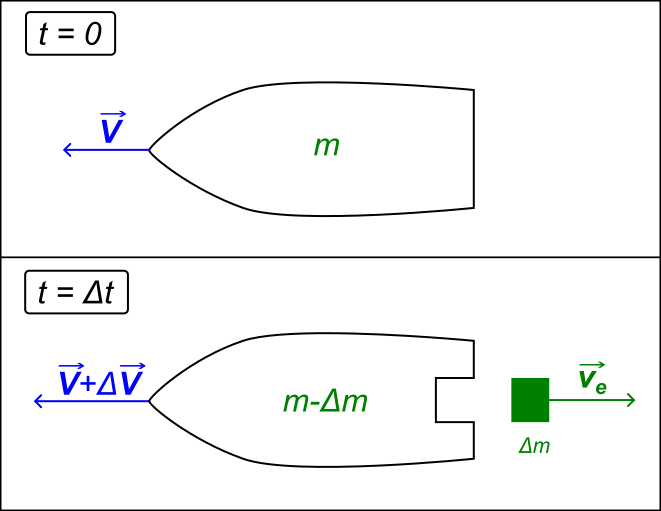
In the following derivation, "the rocket" is taken to mean "the rocket and all of its unexpended propellant".
Newton’s second law of motion relates external forces \(\vec{F}_i\) to the change in linear momentum of the whole system, including rocket and exhaust, as follows:
where \(\vec{P}_0\) is the momentum of the rocket at time \(t = 0\):
and \(\vec{P}_{\Delta t}\) is the momentum of the rocket and exhausted mass at time \(t = \Delta t\):
where, with respect to the observer:
-
\(\vec{V}\) is the velocity of the rocket at time \(t = 0\).
-
\(\vec{V} + \Delta \vec{V}\) is the velocity of the rocket at time \(t = \Delta t\).
-
\(\vec{V}_{\text{e}}\) is the velocity of the mass added to the exhaust, and lost by the rocket, during time \(\Delta t\).
-
\(m\) is the mass of the rocket at time \(t = 0\).
-
\(\left(m - \Delta m\right)\) is the mass of the rocket at time \(t = \Delta t\).
The velocity of the exhaust \(\vec{V}_{\text{e}}\) in the observer frame is related to the velocity of the exhaust in the rocket frame \(\vec{v}_{\text{e}}\) by:
thus,
Solving this yields:
If \(\vec{V}\) and \(\vec{v}_{\text{e}}\) are opposite, \(\vec{F}_i\) have the same direction as \(\vec{V}\), \(\Delta m \Delta \vec{V}\) terms are negligible since \(dm \, d\vec{v} \to 0\), and \(dm = -\Delta m\), since ejecting a positive \(\Delta m\) results in a decrease in rocket mass over time, then:
If there are no external forces, then \(\sum_i F_i = 0\) by conservation of linear momentum, and:
Assuming that \(v_{\text{e}}\) is constant, known as Tsiolkovsky’s hypothesis, it is not subject to integration. The above equation may then be integrated as follows:
This yields:
1.1.2. Summary
This famous rocket equation can be written in several equivalent ways by solving for different variables:
where each of the variables represent the following:
| Δv |
(m/s) Change in velocity of the rocket after consuming all of its fuel. |
| ve |
(m/s) Velocity of the propellant (the "exhaust"). NOTE: this is in the opposite direction of the rocket body, so one of the two velocities will have a negative sign! |
| ms |
(kg) Mass of the (empty) rocket body structure and payload. This does not include the mass of the propellant (i.e. the stones in our story). |
| mf |
(kg) Mass of the fuel loaded into the rocket before launch. |
Rocket and spacecraft propulsion people are always talking about delta-vee this and delta-vee that. This is because orbital motion and space flight is all about velocities; more mass just needs more force for the needed acceleration (which is also Δv).
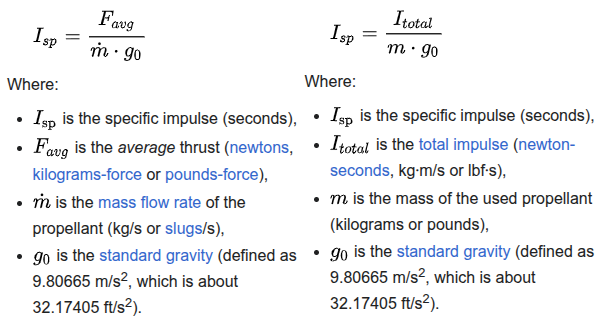
1.2. Specific impulse
then
so \(I_{sp}\) has units of m/s.
Divide by standard gravity g0:
Other versions:
Exhaust velocity:
then thrust:
therefore, it’s all about exhaust velocity!
2. Model rocket engines
Under the docs/ directory, there are a few references having to do with rocket engine testing issues:
Velocity of the exhaust gasses.
We will be using A8-3 single stage engines. Take a minute to find this enginer model in the table below. Pay attention to the units of each of the parameters.
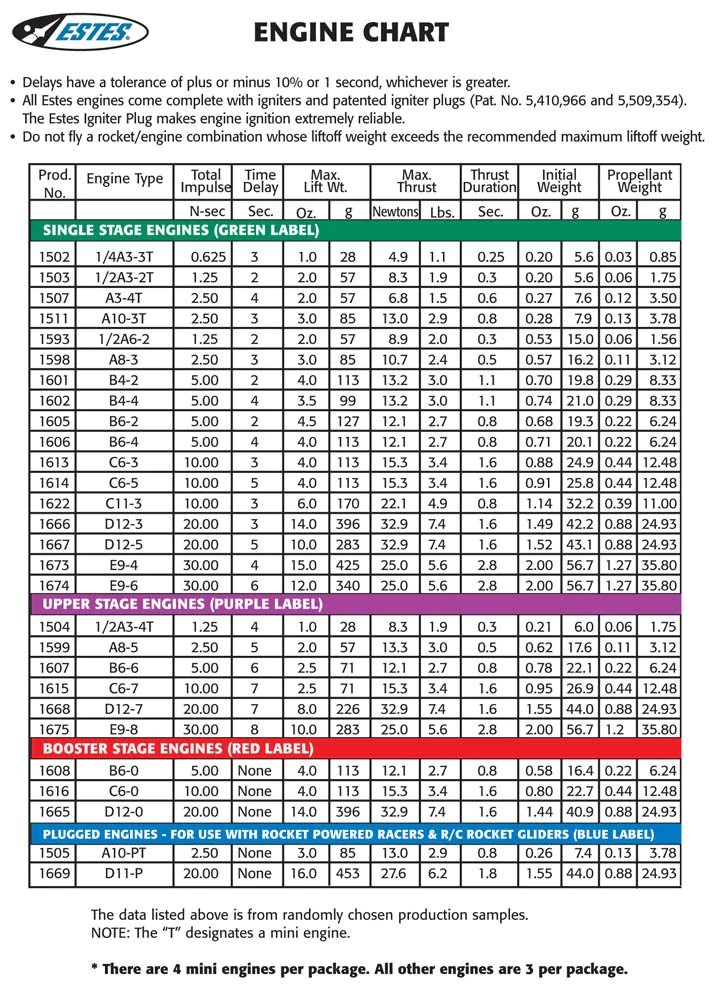
The Total Impulse is the most important number. It represents the force generated by the engine and for how long it does so before burning out.
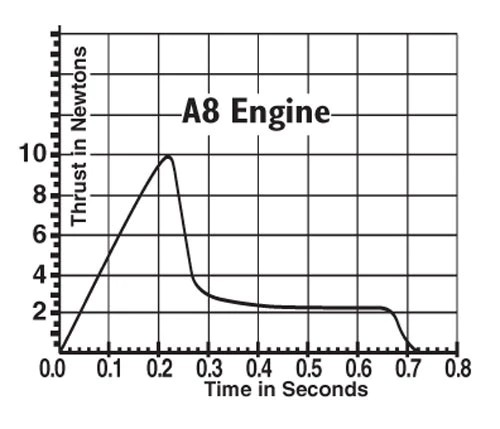
The next figure shows how the force varies with time.
-
dependent axis is in newtons.
-
independent axis is in seconds.
-
so, the area of this shape must be in units of N · s, which is called total impulse.
-
Estes claims this is 2.50 N·s
-
The National Association of Rocketry independently tests engines and reports the following numbers:
-
Total impulse, I: 2.32 N·s
-
Average thrust, Ft: 3.18 N
-
Burn time tburn: 0.73 s
Notice that \(I = F_t \cdot t_{burn}\). You can think of this engine producing this thrust for this time (which has a plot that looks like a rectangle).
Another person measured the thrust of 6 engines and found an average impulse of 2.36 N·s.
Yet another group, testing a slightly different engine model also arrived an an impulse lower than what the manufacturer Estes claims.
Is Estes wrong or using deceptive advertising??
This presentation, Effect of Altitude on Engine Performance, describes experiments done in a test chamber that can simulate the air at different altitudes. They measured the thrust of an engine type and showed that the impulse increases as the altitude increases. Estes is based in Penrose, Colorado at an altitude of 5300 feet. NAR’s testing was done at an altitude of about 600 feet. Valparaiso, Indiana is at 780 feet. These altitude differences are enough to account for the difference in impulse.
But, it is important for us to use a value that matches what we expect to experience at our altitude!
3. Rocket car experiment
3.1. Newton’s second law
For this experiemnt, we are focusing on the relationship between force, mass, and acceleration.
If a force is applied for a certain number of seconds, then we can find the change in velocity or acceleration. Substitute Newton’s second law into the equation for velocity
| Notice the F · t term, this is the impulse! If we know the engine’s impulse and the car’s mass, then we can predict the car’s speed at burnout. |
What is \(v_i\)?
3.2. Measuring acceleration
Smartphones have sensors built in to them that allow them to sense rotation and motion.
The phyphox - physical phone experiments phone app lets us get access to the raw data from these sensors. Specifically the acceleration in x, y, and z axes. It will log this data, and export the numbers to a spreadsheet.
| [demo of phyphox] |
3.3. Computing final velocity from acceleration
Remember:
If you have numbers for acceleration at many time instances, you can compute the change in velocity over those (small) time intervals.
You will use a spreadsheet to compute each velocity change, then add up all of these changes to find the maximum speed the car reaches from equation \(\eqref{vat}\). We are measuring both a and t from the phone.
It is this \(v_f\) that we hope will match our prediction of the final velocity from the engine’s impulse using equation \(\eqref{vi}\). We are using the engine’s impulse from the datasheet and measuring the car’s mass with a scale.