1. Review
The reading of Razavi section 2.2.1 was assigned and expected to have been completed by the start of this class session. Also §2.2.2, but your reading assignments are intentionally ahead of class time topics.
| Symbol | Name | Units |
|---|---|---|
V |
||
n |
||
p |
||
μn |
||
μp |
||
kB |
||
ni |
||
ND |
||
N~A |
||
W, h, d |
- Charge carriers of interest
-
-
e-
-
h+
-
- Charges move by
-
-
Electric field → \(\mathrm{V(olts)_{ab}} = - \int_a^b \vec{E}\,dl\)
-
2. Diffusion
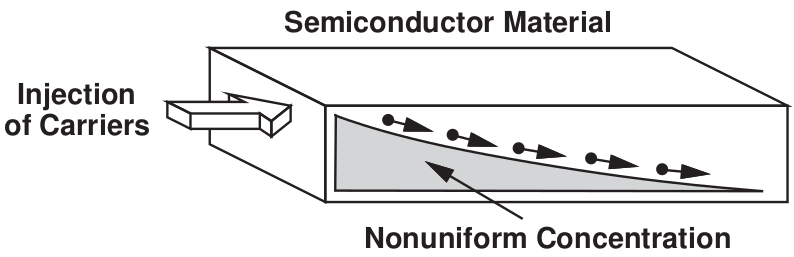
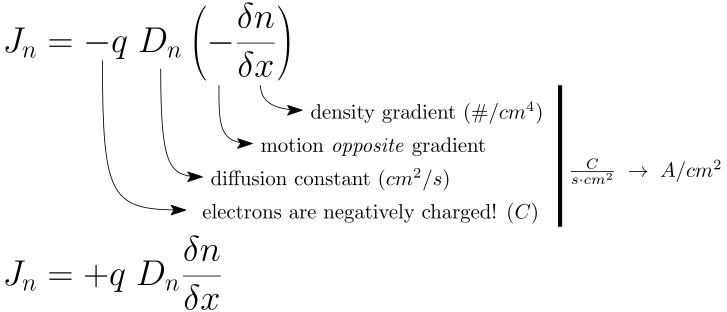
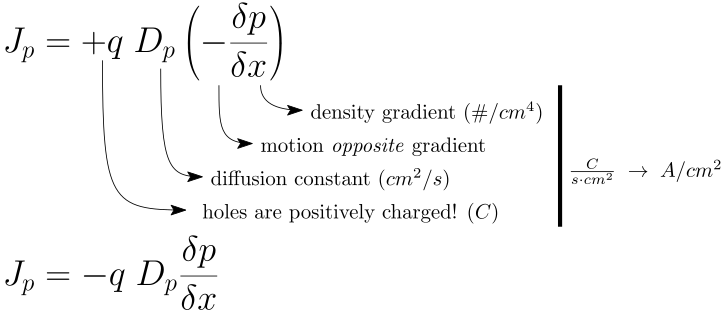
The total diffusion current density is then
| Look back at our four currents in a semiconductor and match the terms we’ve just worked through. Only one term has a negative sign, hole diffusion, be careful to not make sign errors! |
2.1. Einstein relation
Surely there is some relationship between how easily a free charge carrier moves in a semiconductor (μ, mobility) and the quickness that a dose of charge disperses within a volume (Dn,p, diffusivity). Why would this make sense? What is happening internally when charges diffuse?
Indeed, this is the Einstein relation:
I like this last presentation of the relationship best for the intuition on how the diffusion constant changes with temperature. Consider a drop of dye in a class of cold versus hot water — the dye in the hot water will diffuse faster because the thermal motion that creates the movement is greater.